AI-scaffolded Satellite Apps, built in days not months, governed by the Kinetic Semantic Layer — deterministic, auditable, and enterprise-ready.
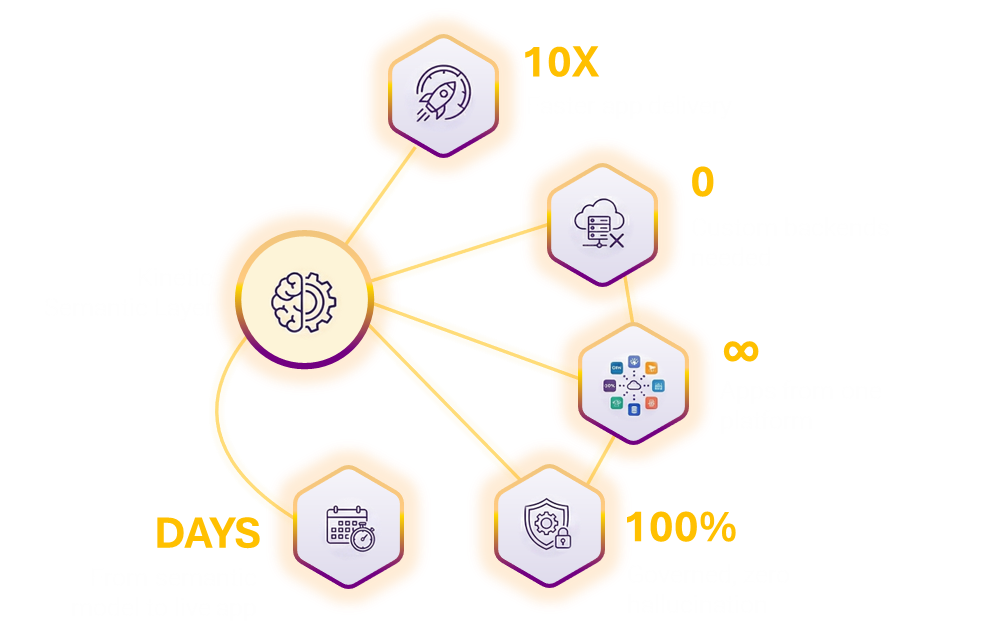
Every enterprise faces the same structural failure — apps built from scratch on raw data with no shared governed foundation.
A single operational app — HRMS, CRM, Finance dashboard — takes 12–18 months of backend development, BI tool configuration, and data integration. By the time it ships, requirements have changed.
Each application owns its own backend, its own data schema, and its own definition of 'Customer', 'Revenue', and 'Risk'. Inconsistent numbers, duplicated effort, and an integration nightmare every time something changes.
'Revenue' calculated five different ways. 'Churned customer' with four definitions. No business rule enforcement. Impressive in the demo. Unreliable in production — with zero accountability.
The root cause of all three problems is the same: every app is built from scratch on raw data with no shared governed foundation beneath it.
Ontology-grounded business objects · governed metrics · pre-authorised actions · deterministic · zero hallucination.
Both modes share: auth · RBAC · connectors · audit trail · semantic definitions.
Thin, domain-focused operational applications built on one shared platform layer — scaffolded by AI coding tools in days, not months.
"Instead of building ten separate apps, you deploy the platform once and spin up satellites as fast as your AI coding tools can scaffold them."
A centralised data and analytics backbone with semantic models, connectors, identity, RBAC, and an SDK. One governed source of truth for every satellite app that consumes it.
Domain-specific apps — HRMS, CRM, Finance, Projects, Support, Risk, Wealth — each consuming the shared SDK. No duplicated backends. No conflicting data definitions.
Claude Code, OpenAI Codex, and Cursor AI read the platform conventions and SDK contracts to scaffold complete feature modules in hours. Humans review and approve.
Auth, role management, data connectors, audit trails, and semantic definitions live once in BDB. Every satellite inherits them automatically. Zero duplication. Security by default.
Production-ready domain applications, scaffolded in days from the BDB Kinetic Semantic Layer. Shared auth, RBAC, connectors, and audit trail — inherited by every app automatically.
Complete workforce management governed by BDB semantic models. No HR data silo, no custom backend — leave approvals, WFH scheduling, and performance tracking with zero backend coding.
Sales pipeline built on governed data. 'Customer' has one definition across every app. Deal stages and revenue are calculated consistently, everywhere — no conflicting numbers.
CFO-grade financial visibility with governed P&L, payroll, and budget tracking. 'Revenue' means the same thing in this app as in every Data Agent and every dashboard.
Project delivery and OKR tracking with shared semantic definitions for milestones, resource allocation, and timesheets — consistent with Finance and HRMS automatically.
Risk · Branch · Wealth · Support · Compliance. Add any domain — extend the semantic model, scaffold in days. Every new app inherits the full platform. Growth is additive, not exponential.
Most semantic layers are read-only metric consistency tools. BDB's Kinetic Semantic Layer is write-enabled, action-aware, and agent-ready — it governs what AI can do with data, not just what data means.
Canonical definitions of every business entity — Customer, Transaction, Product, Risk Score, Account. 'Revenue' is defined once. Every app and every agent uses the same definition. One truth. Everywhere. Forever.
Time, geography, segment, and category dimensions apply consistently across every semantic object. 'Last month' means the same thing whether a Data Agent answers it or a Satellite App displays it. Temporal ambiguity eliminated.
Governed read APIs exposing semantic objects to Satellite Apps and Data Agents. Execute Semantic Query returns certified data. Normalize Rows ensures consistent formatting. Every service call is logged for audit.
Write-back operations with pre-condition validation. A compliance hold cannot be placed on a closed account. A refund cannot exceed the original transaction. Rules encoded once, enforced everywhere.
Three best-in-class AI coding tools integrate with the BDB Platform SDK to scaffold complete satellite apps in days. Quality gate is always human.
useSemanticQuery and useSemanticAction hooks correctly first time.Human in the loop — always. AI scaffolds · engineers review · architects approve · security team signs off before any satellite goes to production. Quality gate is always human. AI accelerates; engineers control.
What this is worth in time, money, and operational sanity.
| Dimension | Traditional Approach | BDB Satellite App Model | Saving |
|---|---|---|---|
| Time to first working app | 12–18 months | 4–6 weeks | 10× faster |
| Backend development cost | $300K–$800K | $0 (SDK inherited) | 100% backend cost saved |
| Data integration effort | 3–6 months per app | Pre-built connectors | Eliminated |
| Auth & RBAC implementation | 4–8 weeks per app | Inherited from platform | 4–8 weeks saved per app |
| KPI consistency across apps | Low — each app defines own | 100% — one semantic model | Governance risk eliminated |
| AI agent reliability | High hallucination rate | Zero hallucination — governed | Production-safe AI |
| Adding a new domain app | Restart from scratch | New semantic model → scaffold | Weeks not months |
Large private bank · Need: Relationship Manager app showing portfolio performance, client 360, and risk alerts · Timeline pressure: Regulatory review in 8 weeks · Existing stack: BDB platform with BFSI semantic model already deployed.
12 weeks backend development
+ 4 weeks BI tool configuration
+ 6 weeks data integration
+ 3 weeks auth/RBAC setup
Total: 25 weeks · $480K estimated
Day 1–2: Semantic model review + 3 new wealth attributes
Day 3–7: Claude Code scaffolds full app from SDK
Week 2–3: UI refinement + human review + QA
Week 4–6: Production-ready — RMs using live app
Total: 4–6 weeks · $60K · 8× cheaper
Five supporting enterprise benefits. One structural truth that compounds with every new domain.
AI coding tools scaffold full feature modules in minutes, not developer-days. A new satellite from concept to production in 2–4 weeks, not 6–18 months. One team maintains the platform and spins up satellites continuously.
Every Data Agent and every Satellite App answers from the same governed Kinetic Semantic Layer. 'Revenue' is calculated one way. 'Customer' has one definition. AI agents cannot act outside pre-authorised conditions. No other platform can make this claim.
Auth, RBAC, connectors, semantic definitions, and audit trails live once in BDB. A ten-app organisation runs one platform, not ten backends. Maintenance cost collapses. Security posture is consistent by default.
Every organisation that deploys BDB once gets the full platform forever. Every new domain is a satellite, not a new system. The economics improve with every app added. The platform gets more valuable, not more complex.
A proven deployment path — from platform installation to a full constellation of domain apps running in production.
BDB is deployed once — on your cloud, on-premise, or hybrid. The Kinetic Semantic Layer is configured for your domain (BFSI, Telecom, Retail, Healthcare, Education, or custom). Connectors mapped to your data sources. Auth and RBAC configured for your roles.
The team selects the highest-priority operational app. AI coding tools scaffold the first satellite — routes, components, semantic query hooks, and auth wrappers — in days. Human review, QA, and UAT. First app live.
With the platform proven, subsequent satellites are added at increasing speed. Each new satellite inherits all platform services. The team's capacity shifts from backend maintenance to product thinking.
Speak with a BDB expert. Get a personalised satellite app roadmap for your industry and data stack.